
Charlottesville · 1813 to today

Minor on the Law

Four generations of one family’s argument with the law.

Halsey Minor · October 25, 2026
“The past is my future.”
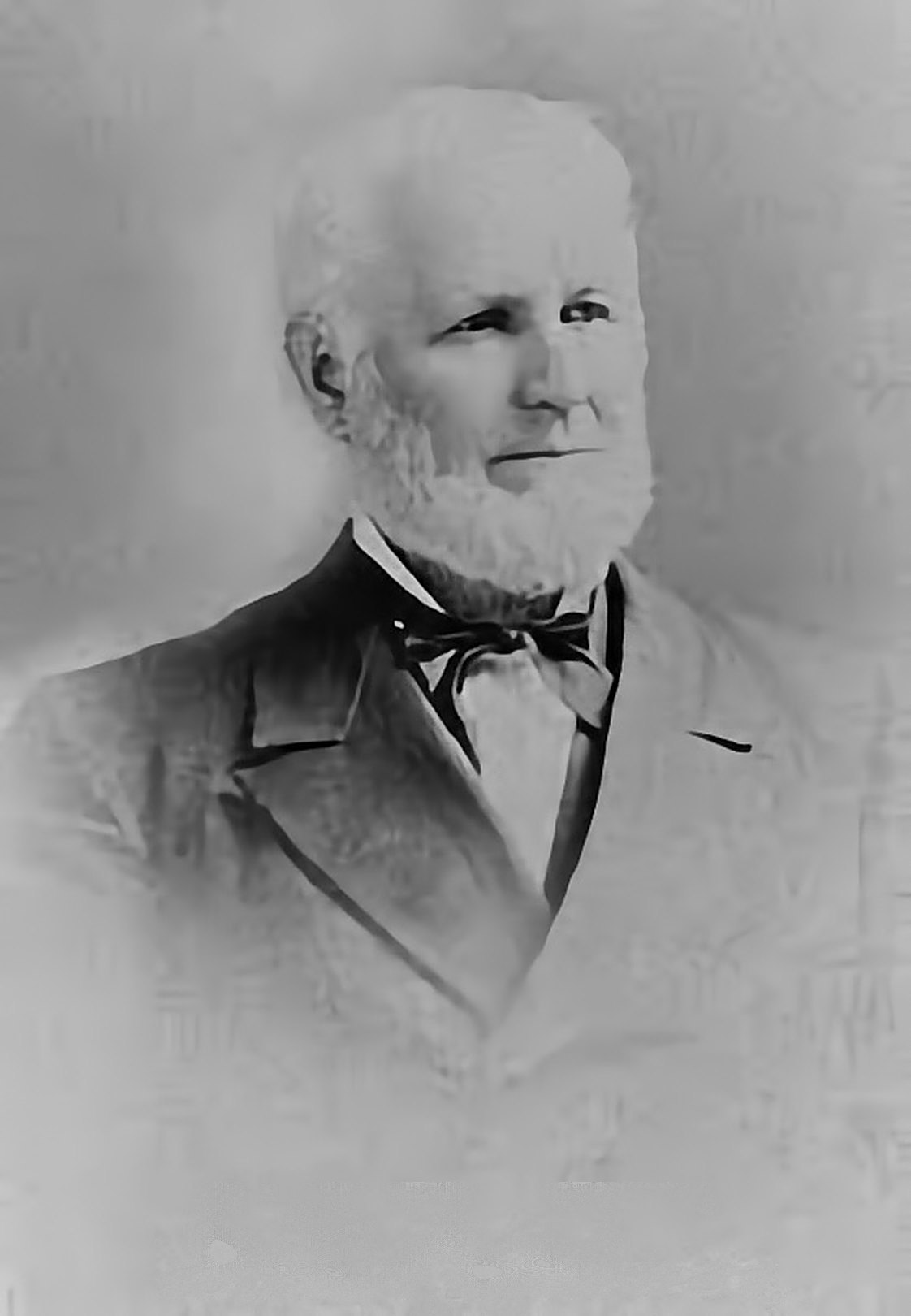
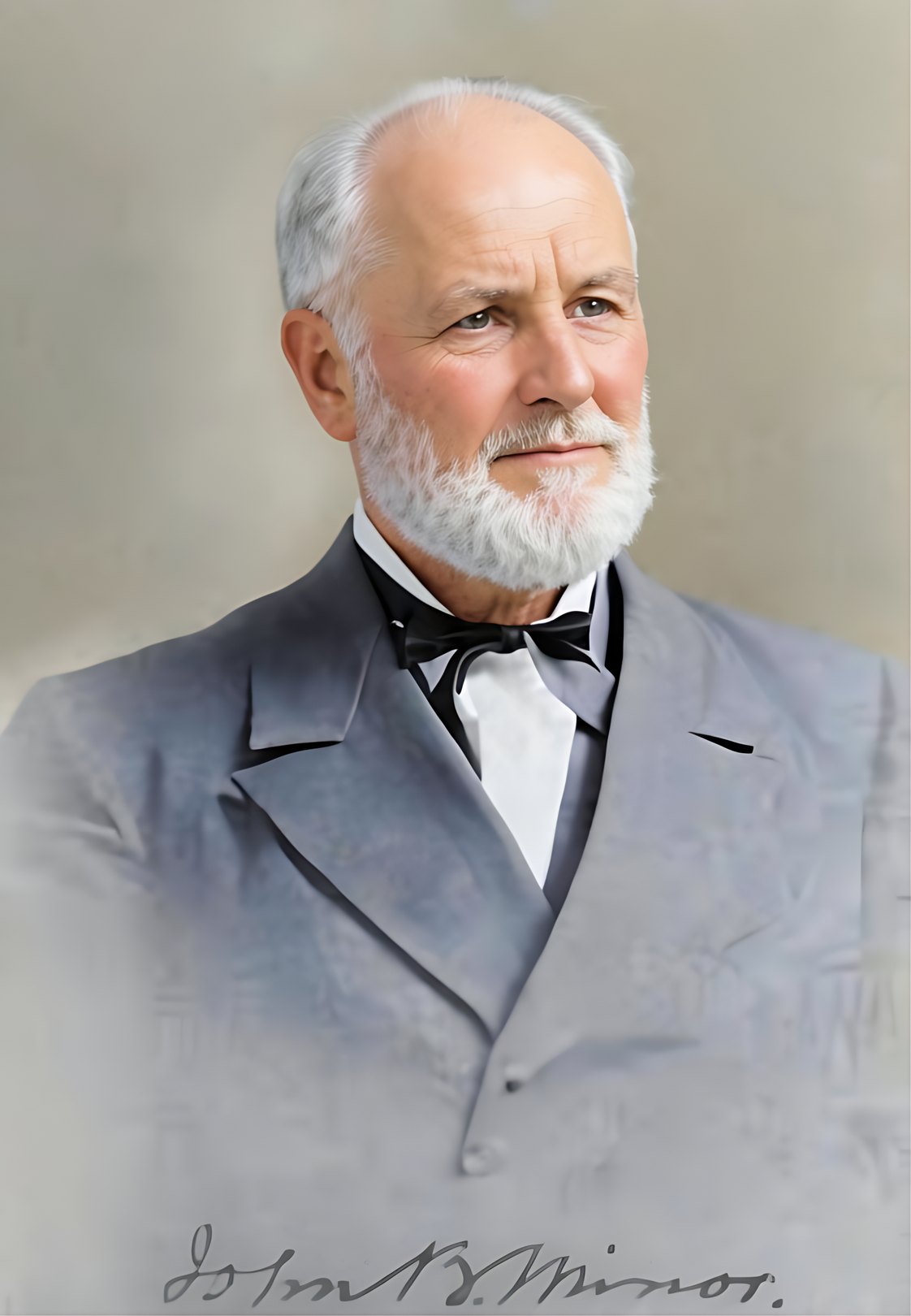
John B. Minor, photographed on 1 October 1884: white hair and a white beard, a dark bow tie and a grey coat. His signature: John B. Minor. John B. Minor as he most likely appeared: the same photograph, reconstructed in realistic color by Halsey Minor.

1884. The photograph, 1 October 1884, with his signature. Arthur J. Morris Law Library Special Collections, University of Virginia. 2026. The same photograph, reconstructed by Halsey Minor as John B. Minor most likely appeared. In motion. The reconstruction set in motion by Halsey Minor with Google Gemini, 2026. The movement, the voice and the words are made by AI, not recorded from him.

Four lives, one university

Each life overlaps the next, and each studied at the University of Virginia : 1834, 1890, 1925, 1987. From 1911 to 1932 the Law School stood in Minor Hall, named for John B. Minor.
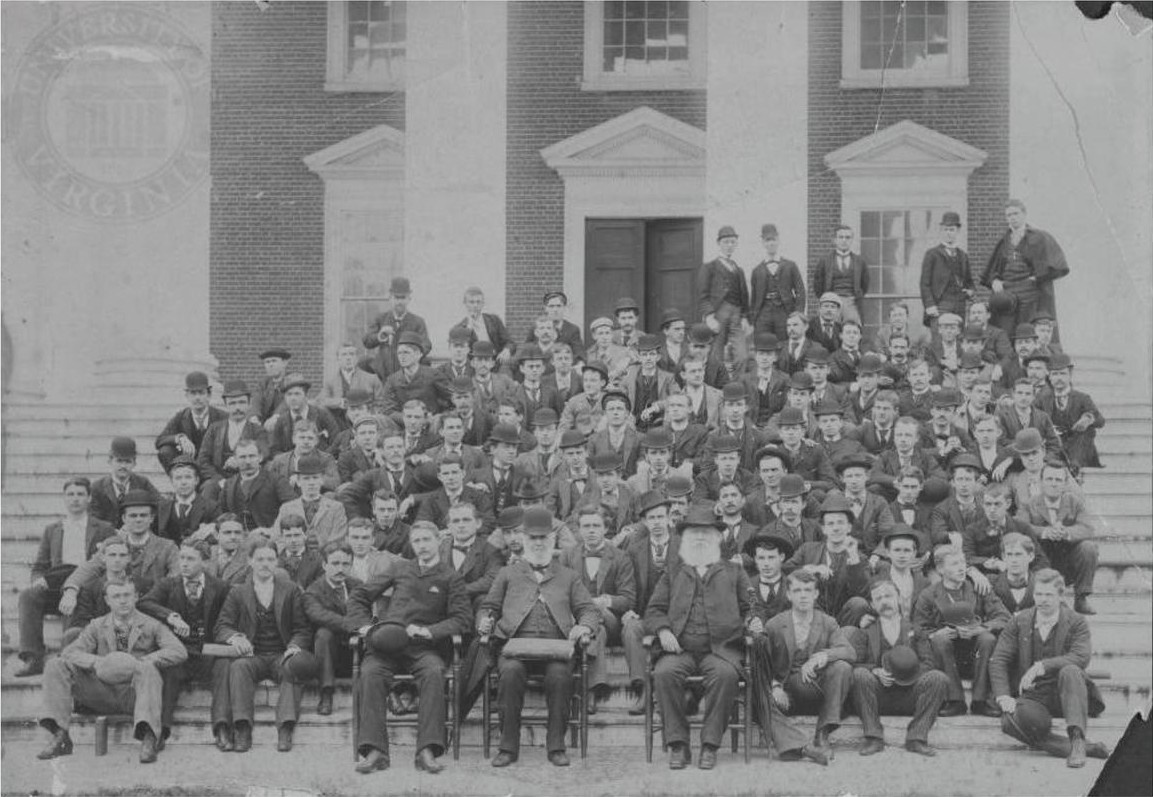
About 1890–1893. Professor John B. Minor with a class of law students, forty-five years into the same appointment. He sits at the center of the front row, as the photograph’s caption records. The photograph: Albert and Shirley Small Special Collections Library, University of Virginia. In color and motion: Halsey Minor, 2026.

Division I · The Teacher

John Barbee Minor

2 June 1813 – 29 July 1895

At sixteen he crossed Virginia on horseback as a newspaper agent, then walked to Ohio to enroll at Kenyon College. Dissatisfied, he walked back.

1834
Bachelor of Laws, University of Virginia, at twenty-one.
1845 – 1895
Professor of Common and Statute Law. Fifty years in one seat.
1853
His law classes move into the new Rotunda Annex.
1865
Walks out under a flag of truce to ask that the University be spared.
From 1875
The Institutes, four volumes, printed at his own expense.
1911
Minor Hall opens, named for him: the Law School’s home until 1932.
Cut into the pedestal of his bust, presented by the law alumni on 12 June 1895, the fiftieth anniversary of his chair
“He taught the law and the reason thereof.”
1845
The fourth to hold Jefferson’s chair of law, at thirty-two, and its only teacher until 1851. In his first ten years, nine students in a hundred passed his examination for the degree.
1850
A new edition of the Virginia Report of 1799–1800, Madison’s Report on the Alien and Sedition Laws, edited by him.
1861 – 1865
Teaches through the war to a handful of students.
3 March 1865
Sheridan’s cavalry under Custer reaches Charlottesville. With the chairman of the faculty and the rector he meets it under a flag of truce: “we requested protection for the University, and for the town”, his diary says. Custer posts a guard, Sheridan confirms it, and the University is spared; the Virginia Military Institute had been burned the summer before. The diary is in the University’s Special Collections.
After Appomattox
With Maupin, borrows money on his own credit so the University can open for the session of 1865–66.
From 1870
A summer course of law lectures, believed the first summer law school in the country; more than a hundred students in a session.
1875 – 1895
The Institutes of Common and Statute Law: volumes I and II in 1875, IV in 1878, III in 1895; four editions in his lifetime. The Law Library’s history calls him “the leading legal professor in the South”.
1879 – 1880
Woodrow Wilson, later President of the United States, studies law under him: a “perfect teacher”, in Wilson’s words.
1884
James C. McReynolds takes his law degree in little more than a year; later Attorney General of the United States and a Justice of the Supreme Court.
Doctor of Laws
Honorary, from Washington and Lee and from Columbia.
1894
Exposition of the Law of Crimes and Punishments, in general use across the country.
29 July 1895
Dies at eighty-two, in the fiftieth year of his chair.
Fifty years
More than six thousand students, by the Law Library’s count. A 1904 history of the University records that his students called his career “not only the longest but the ablest known to Anglo-Saxon jurisprudence”.
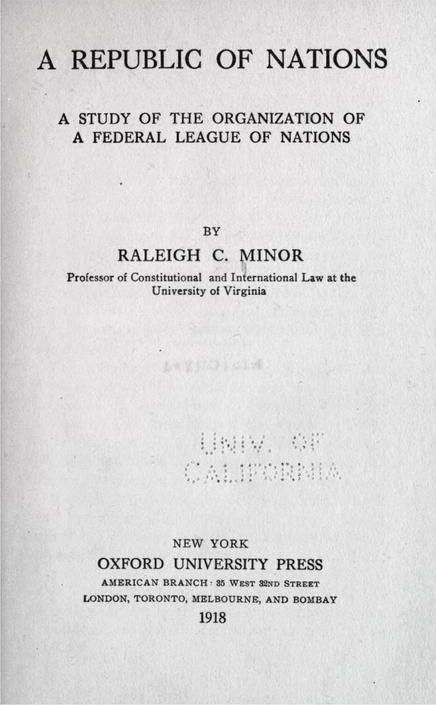
Title page: A Republic of Nations, a study of the organization of a federal league of nations, by Raleigh C. Minor, Professor of Constitutional and International Law at the University of Virginia. New York, Oxford University Press, 1918.
Title page, A Republic of Nations. New York: Oxford University Press, American Branch, 1918. Internet Archive.

Division II · The Architect

Raleigh Colston Minor

1869 – 1923 · Professor of Constitutional and International Law

Three degrees from the University by twenty-one. When the Rotunda burned in 1895, he saved nearly all of the law books.

1887 – 1890
B.A., M.S. and LL.B., University of Virginia.
1893
His father’s assistant; on the law faculty until 1923.
1895
Saves nearly all of the law collection from the Rotunda fire.
1907 – 08
Acting dean of the Law School, University of Virginia.
1908
The Law of Real Property, two volumes, built on his father’s Institutes.
1918
A Republic of Nations, a year before the Covenant.

Virginia State Bar

Past Presidents

  1. E. Griffith Dodson, Jr.
  2. 1962 – 63C. Venable Minor
  3. William E. White
His name on the Bar’s own roll, between E. Griffith Dodson, Jr. and William E. White. Set in type for this page.

Division III · The Practitioner

Charles Venable Minor

1900 – 1988 · Charlottesville, Virginia · Known to his family as Hippo

The first two divisions taught and wrote. The third practiced, and practice does not leave a title page.

1922 · 1925
Bachelor of Science, University of Virginia; Law School, class of 1925, in Minor Hall, named for his grandfather.
1962 – 63
President of the Virginia State Bar.
The firm
Name partner in Perkins, Battle & Minor, then Battle, Neal, Harris, Minor & Williams. In 1966 the Charlottesville firm merged with Richmond’s McGuire, Woods, King, Davis & Patterson to form McGuire, Woods & Battle, today McGuireWoods.
Halsey Minor · October 25, 2026
“He was called the last Southern gentleman, because he was such a kind and considerate individual, and absolutely universally loved.”

The Minor Ventures logo: a hippo standing, with a small bird on its back, above the words Minor Ventures, San Francisco.
Minor Ventures, San Francisco: its logo.

Division III · The Ode

The hippo and the bird

When Halsey Minor started Minor Ventures, he made its logo a hippo with a small bird on its back. Its companies included GrandCentral, now Google Voice, and OpenDNS.

Halsey Minor · October 25, 2026
“The hippo, of course, is my hero, and I am the bird on the back.”
The Rotunda, University of Virginia, drawn for this page. All four studied at the University. John B. Minor’s law classes met in the Rotunda Annex from 1853; when it burned in 1895, Raleigh C. Minor saved the law books, and they stayed in the rebuilt Rotunda until the Law School moved to Minor Hall in 1911.

Division IV · The Reformation

Halsey Minor

1964 –

He did not go to law school. That is the departure. Everything after it is the return.

1987
Anthropology, University of Virginia.
Not changing
The ideal. Equal justice, and the conviction that it is owed rather than sold.
Changing
The venue and the incentive.
The claim
Not a reinvention of the law. A reformation of how ordinary people are required to meet it.
Halsey Minor · October 25, 2026
“I know he would want me to contribute in my way to the system he respected.”

What he is building →

Four generations, one obligation, and no shared method.

Sources: where each fact can be read
  1. John B. Minor: Wikipedia; the University of Virginia Library, John Barbee Minor; The Papers of John B. Minor, 1845–1893.
  2. His chair, his pupils and his books: the Arthur J. Morris Law Library, Minor, John Barbee (1845–1895), and UVA Law, Virginia Teaching: the Early Years; Lyon G. Tyler, Encyclopedia of Virginia Biography (1915), vol. III, pp. 201–202, as transcribed; The Biographical Dictionary of America (1906), vol. VII, Wikisource. Woodrow Wilson: the University of Virginia, Jefferson’s University, the Early Life, and UVA Law, Change Agents. James C. McReynolds: American National Biography. The flag of truce: his diary, 28 February to 7 March 1865, as Encyclopedia Virginia transcribes it, from the Papers of John B. Minor, MSS 3114, Albert and Shirley Small Special Collections Library, University of Virginia; the University of Virginia Library, All the Hoos in Hooville; Virginia magazine, A Civil Occupation (2015); Dictionary of American Biography (1934), vol. XIII. His students: the Law Library’s Legal Knowledge, episode 3; Barringer, Garnett and Page, University of Virginia (1904), vol. I, pp. 356–357.
  3. The Law School, its rooms and Minor Hall: UVA Law, A Timeline of Key Events in UVA Law History; UVA Law, Minor Hall, named for professor, opened in 1911.
  4. The fire of 27 October 1895: the University of Virginia, The Rotunda, History; the Arthur J. Morris Law Library, Library history.
  5. 3 March 1865: the Faculty Minutes of the University of Virginia, 1 March 1865, and the diary of John B. Minor, 2, 3 and 6 March 1865, as quoted in Minor on the Law, Plate III.
  6. Institutes of Common and Statute Law, Vol. I, fourth edition (Richmond, 1891), with the preface to the first edition: Internet Archive.
  7. Raleigh Colston Minor: UVA Law, Archives & Special Collections; the University of Virginia Law Library, faculty profile. John Wurts, The Law of Real Property (Based on Minor’s Institutes) (St. Paul: West Publishing, 1910): Internet Archive. A Republic of Nations (New York: Oxford University Press, 1918): Internet Archive.
  8. C. Venable Minor, President 1962–63: the Virginia State Bar, Past Presidents. The firm: McGuireWoods. Governor John S. Battle: Wikipedia.
  9. Advertising: the American Bar Association, Canons of Professional Ethics, Canon 27 (1908); Bates v. State Bar of Arizona, 433 U.S. 350 (1977): Justia.
  10. Halsey Minor at the University of Virginia, Minor Ventures, GrandCentral (Google Voice) and OpenDNS: Wikipedia; UVA Innovates, CNET.

The archival images are originals; each caption names its collection. The color portrait of John B. Minor is a reconstruction by Halsey Minor from the photograph of 1 October 1884. The Rotunda and the Bar’s roll are drawn and set for this page.

Division I · 3 March 1865

The flag of truce

Sheridan and Custer enter Charlottesville

John B. Minor as a young professor in 1859: dark hair, a high collar and a loose black tie.
1859. Photograph by Adam B. Walter. University of Virginia Prints & Photographs, Albert and Shirley Small Special Collections Library. Public domain.

He was too unwell to attend the meeting at which he was appointed. He went out anyway.

“Resolved that the Chairman & Professor Minor be appointed a committee to meet the commanding General … and request of him a guard to protect public & private property at the University.”
Faculty Minutes, University of Virginia, 1 March 1865
“Most persons think they will destroy the University. I am not of that opinion, but I cannot avoid much anxiety in consequence of so many having a contrary impression.”
Diary of John B. Minor, 2 March 1865

Between one and two o’clock he went with Mayor Christopher Fowler, faculty chairman Socrates Maupin, and Rector Thomas Preston to the ground opposite Carr’s Hill, where a flag of truce had already been raised.

“We announced to these men … that no defense of Charlottesville was contemplated, that the town was evacuated, and that we requested protection for the University, and for the town.”
Diary of John B. Minor, 3 March 1865

Custer passed in triumph with three captured battle flags displayed. Two of his staff rode out of the line to repeat the assurance. What arrived was one man.

“He remained all the afternoon, at the corner opposite the Medical Hall, and was extremely serviceable, and very courteous.”
Diary of John B. Minor, 3 March 1865

By the next day the guard was twenty-five men under Lieutenant David Collins, Company L, Michigan Cavalry. On 5 March a captain of Sheridan’s staff came to state the General’s determination to preserve the University unharmed. Meanwhile the uniform works, Marchant’s factory, the warehouses and the bridges burned.

“Thus we escaped the dangers which threatened, and upon the whole have lost very little. … But our poor neighbors suffered terribly.”
Diary of John B. Minor, 6 March 1865

Of the risk. The Virginia Military Institute had been burned the previous June. Everyone knew it.

Of the tradition. The family holds that guards were posted with orders to fire on any man who tried to burn the place. The archive records the guard, and the courtesy. It does not record the order.

The University of Virginia stands. He was one of the four men who walked out to ask that it be spared.

Division I · The Book

Printed for the author

Institutes of Common and Statute Law · four volumes · Richmond

Title page: Institutes of Common and Statute Law, by John B. Minor, LL.D. Volume I, The Rights Which Relate to the Person. Fourth edition, revised and corrected. Richmond: printed for the author, 1891.
Title page, Institutes of Common and Statute Law, Vol. I, fourth edition. Richmond, 1891. Internet Archive.

He set out to state the whole of the common law of Virginia with more precision than anyone had before, and then he paid the printer himself.

“Printed for the author.”
Imprint, Institutes of Common and Statute Law, Vol. I. Richmond, 1891

There was no publisher standing behind it and no advance. He wrote the treatise, financed the printing, and arranged the distribution through three booksellers. The work went through four editions in his lifetime and shaped the teaching of law across the South for a generation.

“No one can be more surprised than the author at the bulk and character which this work has assumed.”
Preface to the first edition, Institutes of Common and Statute Law

Division II · 27 October 1895

The fire

The Rotunda, University of Virginia

Three months after John B. Minor’s death, a fire broke out in the Rotunda Annex, where the law classes met, and spread to the Rotunda.

It destroyed the Annex and the Rotunda, and most of the University’s library with them.

The law books were kept apart from the rest. Raleigh C. Minor saved nearly all of them. The rebuilt Rotunda gave them room in its basement, and they stayed there until the Law School moved to Minor Hall, named for his father, in 1911.

The University of Virginia, The Rotunda: History · the Arthur J. Morris Law Library, Library history · UVA Law, A Timeline of Key Events

Division II · 1908 – 1910

Built on the Institutes

The Law of Real Property

His own two-volume treatise on real property appeared in 1908, built, as its title records, on his father’s Institutes. Two years later another scholar rebuilt it again on his.

“Credit must be given to Professor Raleigh Colston Minor for everything in this book except the American modifications of the common law, and those I must assume responsibility for.”
John Wurts, preface to The Law of Real Property (Based on Minor’s Institutes), New Haven, 5 January 1910

Each generation took the one before as its foundation and built a new story on it.

Division II · 1918

A league before the League

A Republic of Nations · Oxford University Press

A study of the organization of a federal league of nations, published before there was a league, by a professor in Charlottesville.

The First World War was still being fought when the book went to press. The Covenant would not be drafted at the Paris Peace Conference until the following year.

He was not commenting on an institution. He was drafting the organizational law for one that did not exist, in the hope that someone would need it. Oxford published it at once in New York, London, Toronto, Melbourne and Bombay.

Division III · 1834 – today

The line of the firm

Charlottesville to McGuireWoods

The firm’s line runs back to a Charlottesville practice opened in 1834 by Egbert R. Watson, once private secretary to President Monroe: the same year John B. Minor took his degree a few hundred yards away.

  1. 1834Egbert R. Watson
  2. 1870George Perkins
  3. 1936Perkins, Battle & Minor
  4. ThenBattle, Neal, Harris, Minor & Williams
  5. 1966McGuire, Woods & Battle
  6. TodayMcGuireWoods

In red, the firms that carried his name.

His partner was John Stewart Battle (1890–1972), Governor of Virginia 1950–54, who returned to the Charlottesville practice when his term ended.

Division III · The Last Objection

The question of advertising

1908 – 1977

The idea that a lawyer might advertise was said to have troubled him. It was the settled position of the entire American bar for nearly seventy years, and he held it as a man who had led that bar.

1908
The American Bar Association adopts Canon 27 of the Canons of Professional Ethics, declaring the solicitation of business by advertising unprofessional.
1908 – 1977
The prohibition is adopted by the highest courts of the individual states and holds, substantially unbroken, for nearly seven decades.
1962 – 63
C. Venable Minor presides over the Virginia State Bar under that rule.
1977
Bates v. State Bar of Arizona, 433 U.S. 350, extends commercial-speech protection to attorney advertising. The rule he had defended is struck down.
After
The billboard, the daytime commercial, the injury hotline. He lived another eleven years and saw all of it.

His objection was never to competition. It was to the idea that a person in the worst week of their life should be treated as a market: that distress should be prospected for rather than answered.

Whatever one makes of the rule he defended, the instinct behind it survives intact in the division that follows: what happens to a family should not be the occasion of anyone’s commercial good fortune.